Ophilus and RhOS unveil Khora, a multiplayer world model that powers synchronized AI-generated worlds and demonstrates its capabilities through a public eight-player real-time experience ophilus.ai/khora.
Ophilus has revealed Khora, a next-generation multiplayer world model created in partnership with RhOS. The project tackles one of the most difficult challenges in generative AI: enabling large numbers of people to interact inside the same AI-generated world while keeping every player’s experience synchronized.
Instead of showcasing the technology through technical demonstrations alone, the team has launched a live public experience where eight players can compete against one another in real time. The demo offers an early look at how scalable AI-generated worlds could evolve from research concepts into practical interactive experiences.
A Playable Demonstration of AI-Generated Multiplayer Worlds
Khora’s public demo places players inside a fully generated arena where they battle in fast-paced first-person matches.
Participants can run through detailed environments, engage in live firefights, climb varying terrain, monitor leaderboards, track eliminations, and review match statistics after each round.
Eight players compete in real time in Khora’s public demo at ophilus.ai/khora
While these features resemble those found in modern multiplayer games, the underlying technology is fundamentally different. Rather than relying on manually created game worlds, Khora continuously generates and updates the environment as every player moves and interacts.
The demonstration serves as a real-world test of the model’s ability to deliver responsive gameplay while maintaining consistency across multiple viewpoints.
The Challenge of Keeping Everyone in the Same World
World models have traditionally focused on a single player.
The system predicts what should appear next based on one person’s actions. Looking around, walking forward, or changing direction simply requires generating the next visual frame from that player’s perspective.
Introducing additional players dramatically increases the complexity.
Every participant must experience the same reality.
If one player opens a doorway, everyone else should immediately see the doorway open.
If two players encounter each other in the same location, both viewpoints must accurately represent each player’s movement and position.
Even small inconsistencies can break immersion, making synchronized multiplayer generation one of AI’s most demanding technical problems.
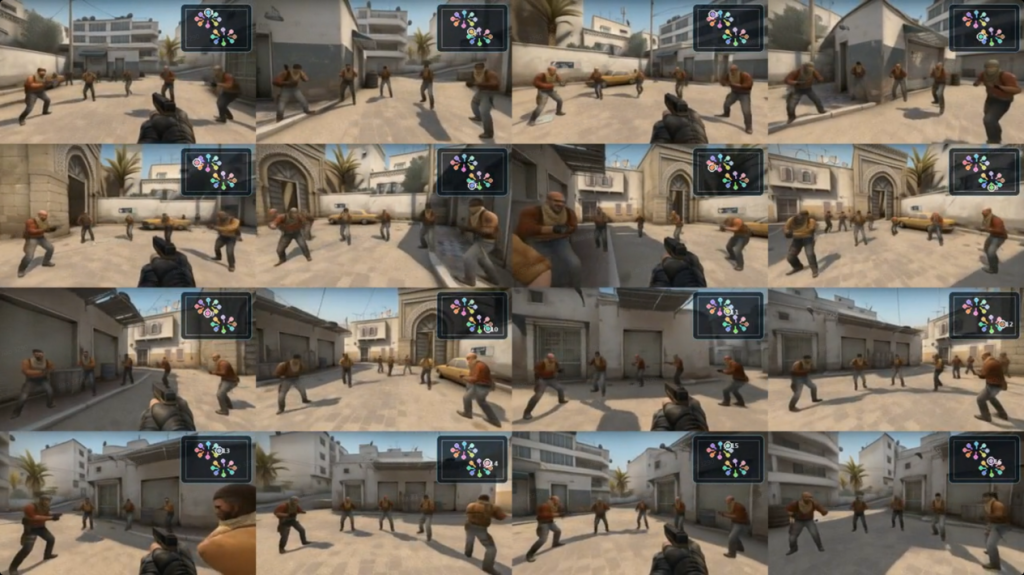
Sixteen generated player views, synchronized through the same evolving world state.
Khora Builds Every Perspective from One Shared Reality
Rather than treating each player as an isolated simulation, Khora creates a shared world that evolves continuously through player interactions.
Whenever someone performs an action, the global world state updates accordingly.
The AI then generates an individualized viewpoint for every participant using that common state as the source of truth.
This architecture allows multiple perspectives to remain synchronized while still rendering each player’s experience independently.
The result is a multiplayer environment where movement, combat, and interactions remain aligned for everyone inside the generated world.
cross agent action consistency in Khora
Building on Earlier Research
Khora follows several important milestones in multiplayer world-model research.
Solaris, introduced by a research team that included Saining Xie, demonstrated that two users could successfully interact inside a jointly generated environment. Its companion platform, SolarisEngine, further contributed by providing an open framework for collecting synchronized multiplayer gameplay data within Minecraft.
Additional projects expanded different areas of the field.
Agora-1 demonstrated impressive real-time world generation in relatively simple environments, while MIRA improved visual fidelity for AI-generated scenes despite supporting only a limited number of simultaneous participants.
These projects established the feasibility of multiplayer world generation, but scaling to larger groups while maintaining real-time performance remained an open challenge.
Khora is specifically designed to address that obstacle.
A Linear Approach to Multiplayer Scaling
Conventional multiplayer architectures often become increasingly inefficient as player counts grow.
When every participant must exchange information directly with every other participant, communication requirements increase rapidly.
With 1,024 players, the system would need to manage more than one million individual communication relationships.
Khora avoids this bottleneck through an architecture known as STBoard, or Spatio-Temporal Board.
Instead of communicating directly with one another, every player interacts with this shared state.
Player actions update STBoard through a state transition model, after which each participant independently generates the next frame using both their local context and the latest shared world information.
Because each viewpoint only references the centralized world state, computational complexity grows linearly rather than quadratically.
According to Ophilus and RhOS, this design represents the first scalable multi-agent world model capable of achieving linear-time complexity while avoiding fixed limits on player count.
Expanding Beyond the Current Demo
Ophilus and RhOS plan to continue advancing Khora with another major release expected in mid-August.
The upcoming update will evaluate the model across a broader range of generated maps, visual styles, and gameplay formats.
The objective is to demonstrate stronger generalization, allowing the system to perform consistently across many different environments instead of excelling only within a single demonstration scenario.
Ophilus’ Long-Term Vision
Khora is part of a broader initiative from Ophilus, a new brand built on Yahaha’s multiplayer 3D creation platform.
By collecting synchronized multiplayer interactions, the company generates valuable training data that helps AI models better understand how shared virtual environments change over time.
The long-term ambition extends beyond gaming.
Ophilus aims to build world models capable of supporting increasingly large numbers of participants while maintaining visual quality, low latency, and synchronized interactions regardless of scale.
Khora marks the company’s first major step toward realizing that vision.
Opportunities Beyond Interactive Entertainment
Although multiplayer gaming provides a natural testing ground, scalable world models have the potential to influence many other industries.
Shared AI-generated environments could support collaborative virtual workspaces, multi-agent AI research, robotics simulation, immersive education, digital twins, virtual production, and interactive storytelling where multiple participants influence the same evolving narrative.
As world-model technology matures, these applications may become just as significant as gaming itself.
Explore Khora
The public eight-player demo is now available for anyone interested in experiencing Khora firsthand.
Ophilus also shares gameplay highlights, development progress, and future announcements through its official X account, alongside updates from RhOS as the platform continues to evolve.
