The origin and popularity of Chinoiserie can be seen as a broad and deep engagement with and imitation of Chinese culture and art by Europe in the 17th and 18th centuries. This period marked the first large-scale collision of Eastern and Western aesthetics in history. This style not only reflected the trade and cultural exchanges between the East and the West at that time but also demonstrated the European fascination and idealization of Oriental culture. Through the imitation and recreation of Chinese aesthetics and craftsmanship, and its widespread popularity among the nobility and wealthy classes, the Chinoiserie style had a profound impact on European art and design.
In the 17th century, as trade between Europe and China gradually increased, Europeans were exposed to a large number of Chinese goods for the first time. These goods were mainly transported to Europe by trading companies such as the East India Company. These luxury items, including porcelain, silk, lacquerware, and tea, were extremely precious and highly sought after in the European market. These goods were not only appreciated for their exquisite craftsmanship and unique aesthetic style but also for their rarity and high prices, making the possession of these Chinese items a symbol of status and prestige among the European nobility and wealthy classes.
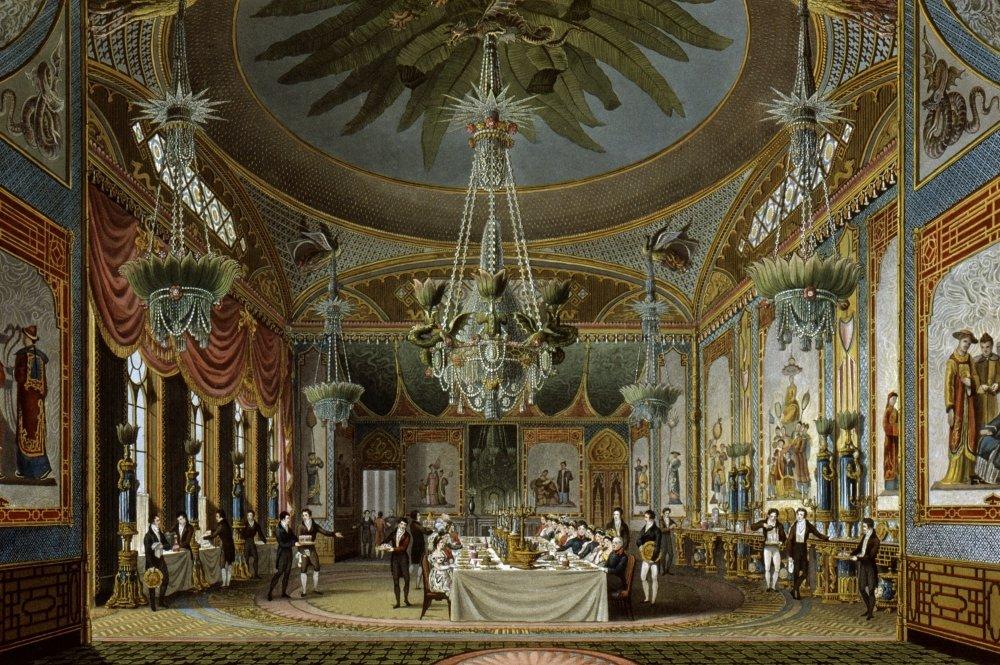
The Banqueting Room of the Brighton Pavilion
The Brighton Pavilion is an exemplary instance of the application of the Chinoiserie style in Europe. Its design and decoration not only demonstrate Europe’s admiration and imitation of Chinese art but also create a unique artistic form through the fusion of different cultural elements, reflecting the depth and breadth of cultural exchanges in Europe from the late 18th to early 19th centuries. The exterior is highly exotic, inspired by Indian Mughal architecture, featuring onion-shaped domes and minarets, presenting an enchanting oriental fantasy. Although the overall design is influenced by Indian architecture, the interior decoration distinctly embodies Chinese style. This fusion makes the Brighton Pavilion a distinctive landmark in European architectural history.
The Banqueting Room is one of the most luxurious rooms in the Brighton Pavilion. Its decoration is extremely lavish, embodying the essence of Chinese style. The ceiling features massive dragon and lotus-shaped chandeliers made of painted glass and metal, employing the classic mix of Chinese themes with Western materials typical of Chinoiserie, creating a mysterious and splendid atmosphere. The walls are adorned with large murals of Chinese figures and landscapes, showcasing bright, rich colors and vivid expressions. These details are depicted using Western shading techniques to highlight the intricacies of Chinese characters, illustrating an imagined Chinese court life. The room’s furniture and decorations also incorporate Chinese elements, such as lacquer cabinets, silk screens, and gem-encrusted furniture.

The Chinese Room in Claydon House
In the expression of decorative arts in 18th-century Britain, although the Chinoiserie style did not accurately reflect true Chinese culture and art, it did not hinder its trend toward “luxury” and “greater complexity.” As one of the most typical examples, the Chinese Room in Claydon House, designed and created by woodcarver Luke Lightfoot in the late 1760s, showcases the boldest and most luxurious aspects of British Orientalist design.
Like most European artists, Lightfoot drew inspiration for the Chinoiserie aesthetic from the works of his contemporaries. He skillfully combined Rococo-style Chinese decorative elements found in the books of William Halfpenny, Matthias Darly, George Edwards, and Jean-Baptiste Pillement to create a bold, eclectic style. These decorations included curvilinear rooflines, bells, lattice railings, and ornamental reliefs, which, despite having no real connection to actual Chinese culture, conveyed a symbolic “Chinese style” through these elements. They featured a blend of Chinese and Western themes, typical Rococo delicacy and lightness, and a sense of swirling motion characteristic of the Rococo style. The “difference” between these representations and authentic Chinese style did not evolve into a more accurate and comprehensive Western understanding but rather formed a fictitious system with its own logic and dialectic. In short, the Chinese Room at Claydon House, through its decorative scheme, showcases the Western fantasy of the East. This fantasy may have little to do with true Chinese culture, but it became part of the decorative arts in 18th-century Britain.
Modern scholars and artists have moved beyond the superficial curiosity of earlier times to a deeper and more respectful understanding of Eastern art and culture. Contemporary Chinoiserie works strive to honor and accurately represent Chinese artistic traditions and philosophy, rather than merely imitating and decorating.

ChuCui Palace Hidden Dragon Earrings
In contemporary Chinoiserie jewelry art, the “Hidden Dragon” earrings by ChuCui Palace bridge the gap between the fierce image of the dragon in Eurocentric Chinoiserie aesthetics and the ethereal and elegant essence of the Eastern dragon. The design employs curves, a characteristic of the Chinoiserie style, to depict the graceful and dynamic form of the dragon. The dragon’s body coils, with its head and tail lines flowing gracefully, aiming to capture the true and beautiful spirit and demeanor, portraying the splendor of life.
ChuCui Palace draws inspiration from the Eastern Five Elements, using the color blue as the primary hue to emulate the purity of traditional Chinese ink painting. The design abstracts traditional Chinese cloud patterns, contrasting simplicity with complexity, and abstraction with realism, creating a rhythmic balance that allows the earrings to sway gracefully. The piece is naturally ethereal, embodying the “bone” beauty of the dragon as well as the exquisite decoration of the blue-green “skin.” The earrings aim to capture the true and rising vitality of the Eastern Azure Dragon, achieving the utmost elegance.
In summary, the Chinoiserie style not only reflects the European fascination and idealization of Chinese culture in the 17th and 18th centuries but also reveals the complexity and contradictions in the cultural exchanges between East and West. This style, through the imitation and recreation of Chinese aesthetics, formed a unique artistic expression that showcased European creativity while also highlighting their misunderstandings and fantasies about Eastern culture. Modern Chinoiserie places more emphasis on respect for and accurate representation of Chinese art and culture. For instance, ChuCui Palace’s jewelry art exemplifies a profound understanding and innovative interpretation of Eastern aesthetics, marking a deeper level of integration and mutual appreciation between Eastern and Western aesthetics in a new historical context. Here comes the importance of language. Consider a chinese lessons singapore to prepare yourself for that culture.
