The rapid development of embodied artificial intelligence is producing increasingly capable robotic models. Yet as these systems become more sophisticated, the industry faces a fundamental challenge: how can their capabilities be measured consistently and reliably?
A successful demonstration does not always reveal how a model will perform when conditions change. Differences in environments, tasks, robot configurations, datasets, and evaluation methods can make it difficult to compare systems fairly or determine whether improvements represent genuine progress.
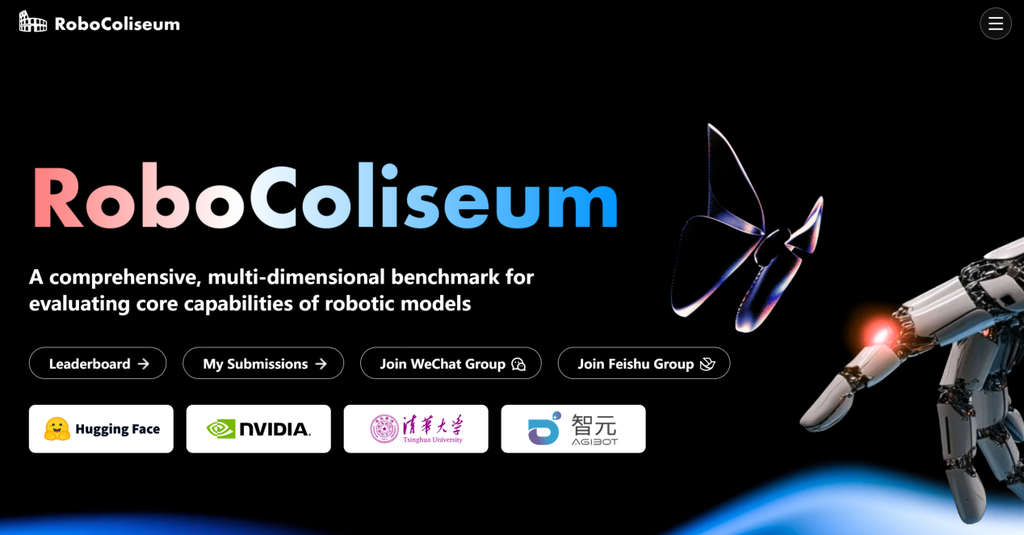
RoboColiseum, a standardized simulation evaluation platform for embodied intelligence, has officially launched to address this challenge. The platform provides a structured evaluation framework designed to measure embodied AI capabilities across multiple dimensions while creating a closer connection between simulated testing and physical robot performance.
The platform is open to universities, research institutions, AI companies, and researchers worldwide. It provides standardized tasks, detailed performance results, leaderboards, and continuously updated evaluations to help developers understand their models and improve them more efficiently.
During its closed beta period, RoboColiseum attracted hundreds of teams from around the world that used the platform to train and evaluate their embodied AI models.
Learn more about RoboColiseum: http://robocoliseum.ai/
Creating a Stronger Connection Between Simulation and Reality
Simulation has become an essential tool in robotics because physical testing can be expensive, slow, and difficult to scale.
However, simulation is only useful when its results provide meaningful insight into real-world behavior.
A robot operating outside a controlled laboratory environment may encounter countless variations. Lighting conditions can change, surfaces can have different physical properties, cameras may introduce noise, and objects may interact differently than expected. Changes to the robot’s initial position or pose can also influence task outcomes.
These variables contribute to the well-known challenge of transferring capabilities between simulated and physical environments.
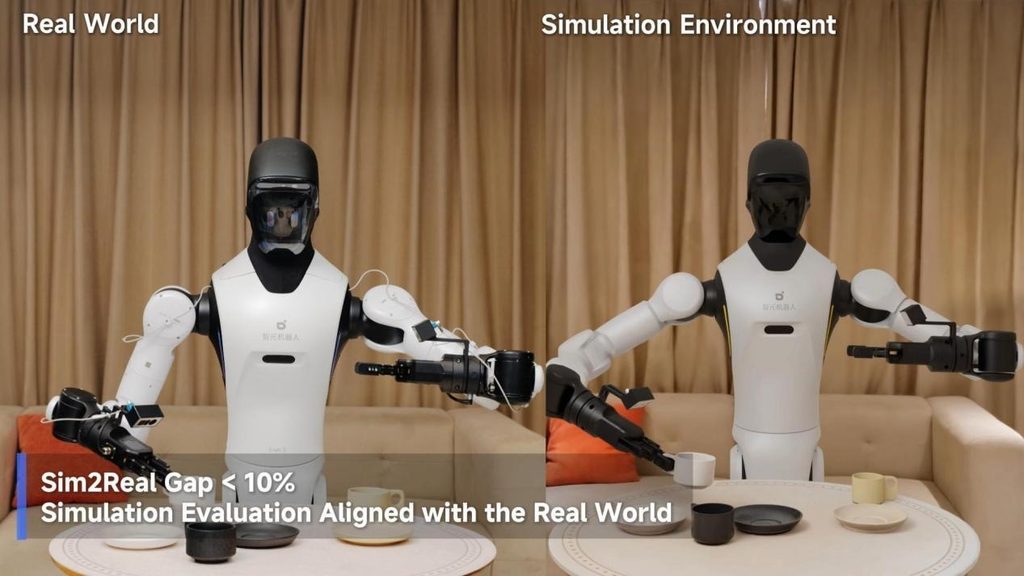
RoboColiseum addresses this issue through a high-fidelity simulation environment that combines photorealistic visual rendering with physically accurate interactions. The objective is to reproduce important aspects of real-world robotic operation closely enough to make simulation-based evaluation useful for measuring practical capabilities.
The platform reports a sim-to-real gap of less than 10% within its evaluation framework. If maintained across relevant scenarios, this level of alignment can make simulation a valuable first-stage testing environment before developers move their models onto physical robots.
This can reduce the amount of hardware testing required during early development and allow researchers to identify problems much faster.
A Two-Way Approach to Sim-to-Real Evaluation
RoboColiseum is designed to support both directions of the simulation and real-world development cycle.
Models trained with physical robot data can be evaluated in simulation to measure their capabilities under standardized conditions. At the same time, models developed primarily through simulation can later be tested on real robots to assess their ability to transfer learned behavior into physical environments.
This creates a more complete evaluation pipeline.
Instead of treating simulation and physical robotics as separate development stages, RoboColiseum connects them through a common evaluation framework.
The resulting workflow can help teams move more efficiently through:
Model Training → Simulation Testing → Failure Analysis → Model Improvement → Physical Validation
For research teams working with expensive robotic hardware, being able to perform extensive evaluation before physical deployment can provide substantial practical advantages.
Four Core Dimensions Reveal More Than a Single Score
Overall success rates can provide a useful snapshot, but they rarely explain what a robotic model can actually do.
A model could achieve a strong overall score while struggling with spatial relationships. Another model might demonstrate excellent manipulation skills but have difficulty understanding complex instructions.
RoboColiseum therefore evaluates embodied AI systems across four major capability categories:
- Instruction Following
- Spatial Reasoning
- Robustness
- Manipulation
The platform currently features four dedicated capability leaderboards and 78 high-fidelity simulation evaluation tasks.
This structure gives developers the ability to examine performance at both the capability level and individual task level.
Rather than asking only whether a model works, researchers can investigate which skills it has mastered and which areas require additional development.
Evaluating Instruction Following
Human instructions are one of the most natural ways to communicate with robots, making language understanding an important component of embodied intelligence.
RoboColiseum evaluates how accurately models interpret instructions involving characteristics such as object color, shape, size, relationships, and logical requirements.
The evaluation focuses on whether the model translates the instruction into the correct sequence of actions.
This distinction is important because understanding a command and physically executing it are connected but separate challenges.
A robot may correctly identify the requested object but perform the wrong manipulation. Conversely, it may possess the necessary physical skills but misunderstand the user’s instruction.
By evaluating instruction following independently, developers can better determine whether language understanding is contributing to a model’s success or failure.
Measuring Spatial Intelligence
Physical environments require robots to understand where objects are located and how they relate to one another.
RoboColiseum tests spatial reasoning through scenarios involving relative positioning, grasping, sorting, stacking, and other interactions.
These tasks require models to combine visual information, geometric relationships, and semantic understanding.
For example, a robot may need to determine which object is positioned to the left of another object, identify the correct target, and then perform a physical action based on that relationship.
Evaluating these abilities independently can help researchers understand how well a model interprets and reasons about three-dimensional environments.
Testing Robustness Against Real-World Variation
Performance in an ideal environment does not necessarily translate into reliable real-world operation.
RoboColiseum therefore introduces more than 10 categories of disturbances into its evaluation process.
These can include changes involving lighting, backgrounds, instruction phrasing, camera noise, gripper configurations, and other environmental factors.
The purpose is to determine whether models can maintain their performance when familiar conditions are altered.
Robustness testing is especially important for models intended for practical deployment. A system that depends heavily on one camera configuration or a fixed environment may perform well during demonstrations but struggle when exposed to new conditions.
By systematically introducing variation, RoboColiseum provides developers with another way to measure the generality of their models.
Assessing Manipulation From Basic Skills to Long-Horizon Tasks
Manipulation is at the heart of many robotic applications.
Picking up an object, moving it, placing it accurately, and interacting with multiple objects may appear simple to humans but can involve considerable complexity for an autonomous robot.
RoboColiseum evaluates atomic manipulation skills across different environments and difficulty levels.
These fundamental abilities are then incorporated into more complex, long-horizon tasks that require models to combine multiple actions.
This tiered evaluation approach can reveal whether a model struggles with a particular physical skill or with coordinating several skills over an extended sequence.
Such information can be valuable during model development because it points researchers toward specific areas for improvement.
Breaking Down Failures Instead of Reporting Only Success
One of the most useful aspects of a detailed evaluation system is its ability to explain failures.
A final task score can tell developers that something went wrong, but it does not necessarily reveal where the problem occurred.
RoboColiseum divides evaluation tasks into multiple subtasks and tracks model performance throughout the process.
The platform can record which steps were completed, where failures occurred, and how performance changes across different scenarios.
This provides researchers with more actionable information.
For instance, a model might correctly understand an instruction and locate the target object but fail during the final grasping step. Such a result points to a manipulation problem rather than a language-understanding problem.
This level of detail can help teams prioritize their development efforts.
Reducing Evaluation Bias Through Diverse Scenarios
A reliable benchmark needs to distinguish genuine capabilities from performance that results from familiarity with a particular environment.
If a model repeatedly encounters identical layouts or predictable conditions, its performance may not accurately represent its ability to generalize.
RoboColiseum uses large and diverse evaluation samples to reduce the influence of these factors.
Its methodology includes domain randomization, separate training and testing datasets, and both in-distribution and out-of-distribution evaluations.
These mechanisms are intended to create more challenging and representative tests.
The result is a benchmark designed to measure how well models generalize rather than simply how well they perform on familiar configurations.
Faster Evaluation Through an Automated Platform
Creating a robotics evaluation pipeline independently can require considerable engineering effort.
Teams may need to configure simulation environments, integrate assets, prepare datasets, manage infrastructure, and build evaluation systems before testing can begin.
RoboColiseum aims to remove much of this complexity through an automated evaluation service.
Developers can reportedly register and submit a model in around five minutes, deploy it with a one-click process, and complete simulation evaluations in approximately 30 minutes.
Once testing is finished, the platform provides detailed scores, task-level results, and videos showing model execution.
These results give researchers both quantitative measurements and visual evidence of how their systems behave.
Connecting Models Without Uploading Code and Weights
RoboColiseum is also designed to accommodate development workflows where researchers prefer to keep their model infrastructure local.
Instead of uploading model code and weights directly to the platform, developers can deploy an inference service within their own environment.
That service can then connect to RoboColiseum through a standardized interface.
This approach allows existing models to participate in evaluations without requiring teams to restructure their entire development environment.
For organizations working with proprietary systems or complex infrastructure, this can provide additional flexibility when conducting benchmark evaluations.
Natural-Language Interaction Through AI Agents
The platform also incorporates AI Agent functionality into the evaluation workflow.
Developers can use natural-language interaction to perform activities such as obtaining data, training models, validating them locally, and submitting evaluations.
The goal is to reduce the amount of manual configuration required throughout the development process.
As AI Agents become more capable, integrating them into robotics workflows could make it easier for researchers to move between experimentation, testing, and analysis.
RoboColiseum’s approach places these capabilities within a standardized evaluation environment.
Benchmarking Against Established Embodied AI Models
A benchmark becomes more useful when researchers can compare new systems against established models.
RoboColiseum provides baseline results for several prominent embodied foundation models, including ACoT-VLA, π0, π0.5, and GR00T.
Developers can compare their submitted models against these baselines across the platform’s four major capability dimensions.
This makes it easier to determine whether a new approach is competitive and where its performance differs from existing systems.
Instead of evaluating a model in isolation, researchers can place its results within a common benchmark framework.
Supporting Reproducible Research
Reproducibility is critical for meaningful progress in AI research.
If different teams use different environments, tasks, and evaluation procedures, comparing their results can become difficult.
RoboColiseum supports reproducibility by providing training code and corresponding weights for baseline models on platform tasks.
Researchers can use these resources to reproduce training procedures, verify baseline results, and conduct further experiments under comparable conditions.
This common foundation can make it easier for researchers to validate findings and build new work on top of previous results.
From Evaluation Arena to Continuous Training Ground
The name RoboColiseum reflects the platform’s broader philosophy.
Like an arena, it provides a common environment where different models can be evaluated under standardized conditions.
At the same time, it serves as a training ground where developers can repeatedly test their systems, discover weaknesses, improve their models, and measure progress.
This creates a continuous feedback loop.
Instead of evaluating a model only when development is complete, teams can integrate benchmarking into their regular development process.
A model can be tested, its failures analyzed, improvements introduced, and the updated version evaluated again.
This cycle can turn benchmarking from a final checkpoint into an active component of model development.
Building a More Transparent Embodied AI Ecosystem
The rapid expansion of embodied AI has created a growing need for common standards.
Researchers and companies need to know whether improvements are genuine, whether models generalize to new situations, and how different systems compare under equivalent conditions.
RoboColiseum aims to contribute to this effort by providing an open evaluation environment for the global embodied AI community.
The platform welcomes universities, research institutions, AI companies, and individual developers to participate.
It also encourages developers to open-source their models and contribute them to the platform, supporting a more collaborative research ecosystem.
Looking Beyond Demonstrations
Robotics demonstrations can be impressive, but isolated success cases do not necessarily represent broad capability.
A dependable embodied AI model needs to perform consistently across different tasks and environments.
It needs to understand instructions, reason about space, manipulate objects, and remain effective when conditions change.
More importantly, developers need reliable ways to measure those abilities.
RoboColiseum’s standardized approach is designed to help move embodied AI evaluation beyond individual demonstrations and toward repeatable measurements.
By combining multiple capability categories, diverse tasks, robustness testing, detailed failure analysis, model baselines, and reproducible training resources, the platform provides a broader view of embodied intelligence.
A New Step Toward Measurable Robotic Intelligence
The launch of RoboColiseum comes as embodied AI enters an increasingly competitive stage.
As foundation models become more capable and robotic applications become more sophisticated, standardized evaluation will become increasingly important.
RoboColiseum aims to provide developers with a practical environment where they can measure performance, identify weaknesses, compare models, and accelerate development without relying exclusively on expensive physical testing.
Its long-term vision is to establish an evaluation infrastructure that evolves alongside the embodied AI field.
By giving models a common arena for testing and developers a repeatable environment for improvement, RoboColiseum seeks to help the industry move toward robotic systems that are not only impressive in demonstrations but also reliable, measurable, and capable of performing in the real world.
RoboColiseum is now officially open to developers and researchers worldwide.
Explore RoboColiseum: http://robocoliseum.ai/
